





1 min read
Try it in your own Jira.
All VIP.LEAN apps run on Forge and come with a free trial on the Atlassian Marketplace.
All VIP.LEAN apps run on Forge and come with a free trial on the Atlassian Marketplace.
Project scope planning with the Work Breakdown Structure (WBS). Covers the planning process, structuring principles, design rules, and the top-down approach.

(TU-Munich, 1997). 29 years of experience as a project, program and portfolio manager. Certified as a SAFE Agilist, Project Manager (GPM) and Scrum Master.

The project scope planning is part of the project scope management. In this post, we will focus on project scope planning. A core element of project scope planning is the work breakdown structure.
Project planning is a central and very important technique of project management. Planning is essential to complete a project successfully.
Project planning is an important prerequisite for project controlling. The earned values analysis for example requires project planning and a WBS. See our posts:
A clear and formally approved project order with the desired project scope and project budget is the basis for starting project planning. The project scope includes:
The definition of the project order can be part of the project initiation phase or provided by an internal business department or an external customer.
To monitor and complete a project successfully a clear project order, entry criteria and a systematically structured planning process are needed.
The project has a unique timeline and achieves deliverables following unique requirements and fulfilling unique goals. Therefore the planning process is very crucial as a creative act projecting the planned execution into the future. The basis of precise project planning is the determination of individual goals, which should be SMART (Specific, Measurable, Achievable, Realistic, Time Bound).
The goals should be already aligned with the most important stakeholders and checked and approved in the context of a clear business case.
We recommend setting requirements at least on the epic level before beginning the project planning process. The requirements should also be SMART and related to the project goals they meet (traceability requirements to Goals).
Based on the project goals and main requirements a preliminary estimation leads to an approved budget envelope. The project goals, requirements and budget framework build in general the project charter.
Project planning includes according to PMBOK the following primary and secondary planning processes:
Core Planning Processes:
Secondary planning processes:
Project scope management deals with the planning, monitoring and control of the project scope. A core element is the work breakdown structure. All projects require a detailed description of the project work and deliverables.
Please differentiate between:
The Project Management Body of Knowledge defines the work breakdown structure as a hierarchical decomposition of the total scope of work that must be performed by the project team to achieve the project goals and produce the required deliverables.
As soon as the project charter and scope statement are clearly defined the project manager can start to break down the work. This is the most crucial task to establish a planning baseline for subsequent steps. The work breakdown structure is the most valuable, easiest and most underestimated project management tool.
A project is generally a complex undertaking and needs to be decomposed into manageable scope sub-components. The result is the work breakdown structure (WBS). The complete WBS is a hierarchical display of all elements of a project scope.
Through the WBS a project is divided into subtasks and work packages. Hierarchical WBS subtasks are elements that must be further subdivided, work packages are elements at the lowest level.
The WBS covers the complete project scope. All child WBS elements describe completely the scope of the parent WBS element without overlap.
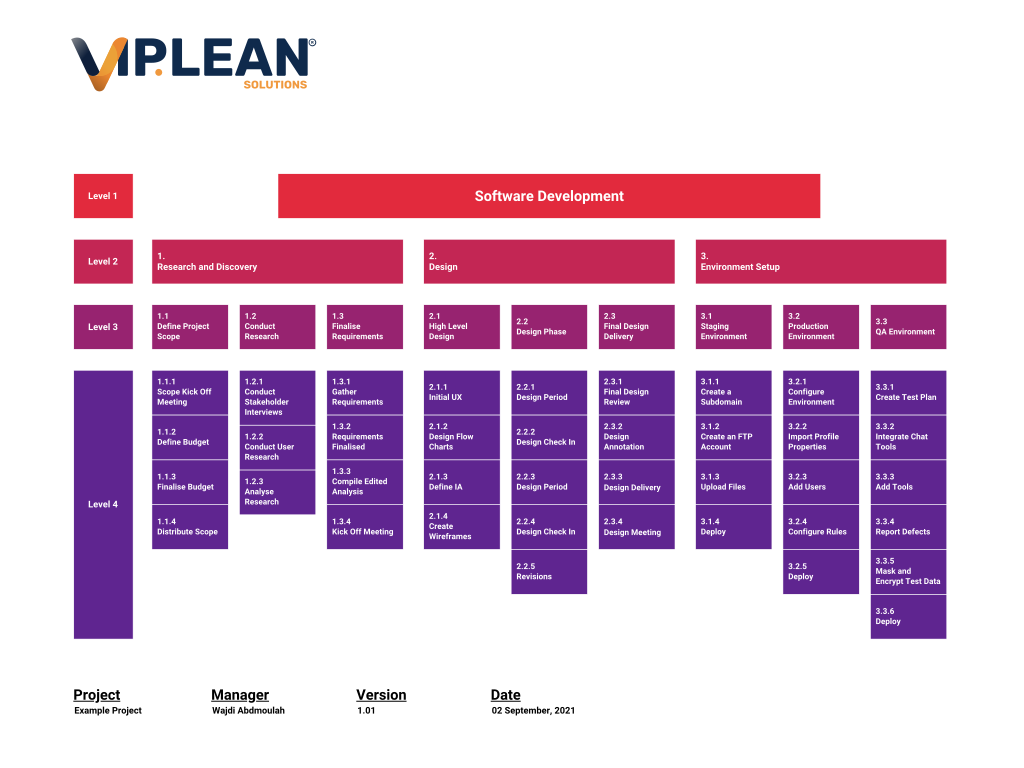
When a project is very large, it is divided into sub-projects. It is recommended to only divide the project into sub WBS elements until the lowest level of the work packages is reached. Each element gets a unique identifier known as the WBS code.
At the beginning of the planning process, sufficient information is not always available. WBS tasks in the far future are considered as planning work packages to be detailed later on.
The 100% rule states that the WBS includes 100% of the work defined by the project scope and captures all deliverables.
The WBS must also clearly document which WBS elements are purchased from suppliers and which are developed internally.
To make sure that the complete project scope is planned, it is necessary to plan the proposed outcomes or results rather than the activities.
.svg)